

Paraffin Wax in Industry: Applications, Benefits, and Industrial Uses
Paraffin wax is one of the most widely used petroleum-derived materials across modern industries. Thanks to its excellent water resistance, chemical stability, electrical insulation, and cost-effectiveness, manufacturers use paraffin wax in thousands of products worldwide. From candle production and packaging to cosmetics, pharmaceuticals, rubber, textiles, and electrical applications, paraffin wax continues to play an important role in industrial manufacturing.
Selecting the correct paraffin wax grade helps manufacturers improve product quality, increase production efficiency, and reduce manufacturing costs.
Why Is Paraffin Wax Used in Industry?
Industrial manufacturers choose paraffin wax because it offers a unique combination of physical and chemical properties.
Key advantages include:
Table of Contents
Toggle- Excellent moisture resistance
- Good thermal stability
- Reliable electrical insulation
- Low chemical reactivity
- Smooth surface finish
- Easy processing
- Cost-effective performance
- Long shelf life
These properties make paraffin wax suitable for a wide variety of industrial applications.
Paraffin Wax in Candle Manufacturing
The candle industry remains one of the largest consumers of paraffin wax. Manufacturers use different grades depending on the desired appearance, hardness, and burning performance.
Common candle applications include:
- Pillar candles
- Container candles
- Tealight candles
- Decorative candles
- Religious candles
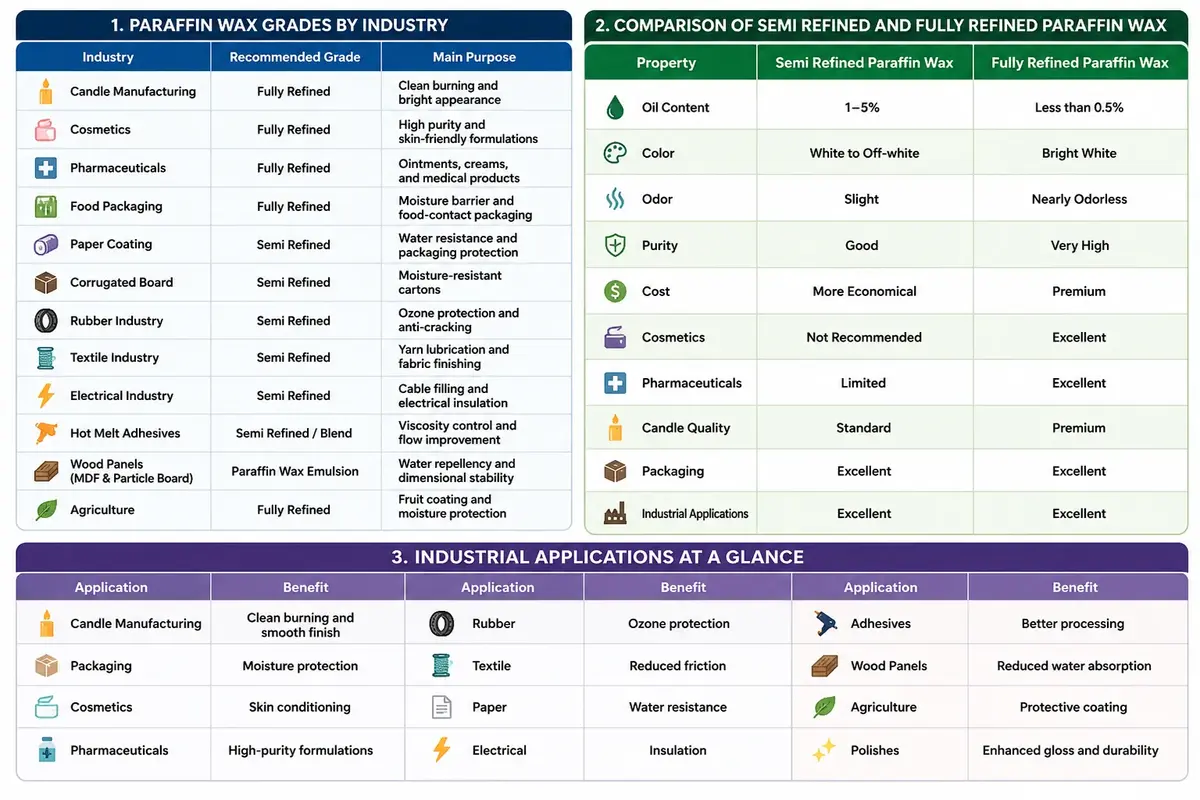
Fully refined paraffin wax is generally preferred for premium candles because of its high purity, bright color, and cleaner burning characteristics.
Paraffin Wax in Paper and Packaging
Paraffin wax improves the moisture resistance of paper products and packaging materials. Wax-coated paper helps protect products during transportation and storage.
Typical applications include:
- Wax paper
- Corrugated board
- Food packaging
- Industrial wrapping paper
- Moisture-resistant cartons
Semi refined paraffin wax is commonly used for these applications due to its excellent performance and economical cost.
Paraffin Wax in the Cosmetic Industry
Cosmetic manufacturers use highly refined paraffin wax in various personal care products because of its purity and consistency.
Common cosmetic applications include:
- Skin creams
- Beauty treatments
- Paraffin bath therapy
- Moisturizing products
- Spa treatments
The gentle texture and stable composition make fully refined paraffin wax suitable for many cosmetic formulations.
Paraffin Wax in Pharmaceutical Products
Pharmaceutical-grade paraffin wax is used in medical and healthcare products where purity is essential.
Applications include:
- Ointments
- Medical creams
- Protective coatings
- Topical formulations
Manufacturers follow strict quality standards to ensure product safety and consistency.
Paraffin Wax in the Rubber Industry
Rubber manufacturers use paraffin wax to improve product durability and protect rubber surfaces from ozone cracking and environmental exposure.
It is commonly used in:
- Tires
- Rubber hoses
- Industrial seals
- Rubber belts
- Technical rubber products
Paraffin wax migrates to the rubber surface and forms a protective layer during service.
Paraffin Wax in Textile Manufacturing
The textile industry uses paraffin wax to improve processing efficiency and fabric performance.
Typical applications include:
- Thread lubrication
- Fabric finishing
- Water repellency
- Yarn processing
- Surface protection
These applications help reduce friction while improving production speed.
Paraffin Wax in Electrical Applications
Because paraffin wax provides excellent electrical insulation, manufacturers use it in several electrical products.
Applications include:
- Cable filling compounds
- Electrical insulation
- Moisture protection
- Transformer accessories
- Industrial electrical components
Its insulating properties help improve product reliability in demanding environments.
Paraffin Wax in Adhesives and Hot Melt Products
Paraffin wax is widely used in hot melt adhesive formulations to improve processing and product performance.
Benefits include:
- Better flow properties
- Improved viscosity control
- Faster setting time
- Enhanced processing stability
Manufacturers often blend paraffin wax with other waxes to achieve specific formulation requirements.
Paraffin Wax in Wood and Construction
Wood processing industries use paraffin wax to improve moisture resistance and increase product durability.
Applications include:
- MDF panels
- Particle board
- Plywood
- Engineered wood products
Wax emulsions containing paraffin help reduce water absorption during production.
Paraffin Wax in Agriculture
Agricultural industries use paraffin wax for several specialized purposes.
Examples include:
- Fruit coating
- Seed protection
- Moisture barriers
- Grafting applications
These applications help improve storage performance and reduce moisture loss under controlled conditions.
Choosing the Right Paraffin Wax Grade
Selecting the correct paraffin wax depends on the intended application.
Fully Refined Paraffin Wax is generally recommended for:
- Cosmetics
- Pharmaceuticals
- Premium candles
- Food-contact packaging
Semi Refined Paraffin Wax is commonly used for:
- Packaging
- Rubber
- Textile
- Paper coating
- Industrial manufacturing
Choosing the appropriate grade improves production efficiency while reducing manufacturing costs.
Advantages of Paraffin Wax for Industrial Applications
Industrial manufacturers continue to rely on paraffin wax because it provides:
- Stable quality
- Easy processing
- Competitive cost
- Excellent versatility
- Reliable performance
- Wide application range
- Consistent product quality
These advantages make paraffin wax one of the most valuable materials in modern manufacturing.
Frequently Asked Questions
Which industries use paraffin wax?
Paraffin wax is widely used in candle manufacturing, packaging, cosmetics, pharmaceuticals, rubber, textiles, adhesives, agriculture, electrical products, and construction materials.
Why is paraffin wax used in packaging?
It creates a moisture-resistant barrier that helps protect products during storage and transportation.
Which paraffin wax is suitable for cosmetics?
Fully refined paraffin wax is preferred because of its high purity, low oil content, and consistent quality.
Is paraffin wax used in electrical products?
Yes. Paraffin wax provides excellent electrical insulation and moisture protection for various electrical applications.
Can paraffin wax be used in hot melt adhesives?
Yes. Manufacturers use paraffin wax to improve flow characteristics, processing efficiency, and viscosity control in hot melt adhesive formulations.
What is the difference between industrial and cosmetic paraffin wax?
Industrial Paraffin_wax is mainly used in manufacturing processes, while cosmetic paraffin wax undergoes additional refining to achieve higher purity for personal care applications.
Conclusion
Paraffin wax remains one of the most versatile materials used across modern industries. Its excellent moisture resistance, thermal stability, electrical insulation, and processing performance make it suitable for applications ranging from candles and packaging to cosmetics, pharmaceuticals, rubber, textiles, adhesives, and construction. Selecting the appropriate paraffin wax grade helps manufacturers achieve better product quality, improve efficiency, and meet the technical requirements of their specific industry.
