
LDPE Wax Supplier | Low Density Polyethylene Wax

What Is LDPE Wax?
LDPE Wax, also known as Low Density Polyethylene Wax, belongs to the polyethylene wax family. It has a lower molecular weight than standard LDPE resin.
Unlike LDPE resin, producers mainly use this wax as an additive rather than as the main polymer. For example, it can act as a lubricant, dispersing aid, flow modifier, or release agent.
Therefore, the material can support many polymer processes. However, technical properties vary between grades.
For this reason, buyers should review the TDS and COA for the exact grade before confirming an order.
Industrial Applications
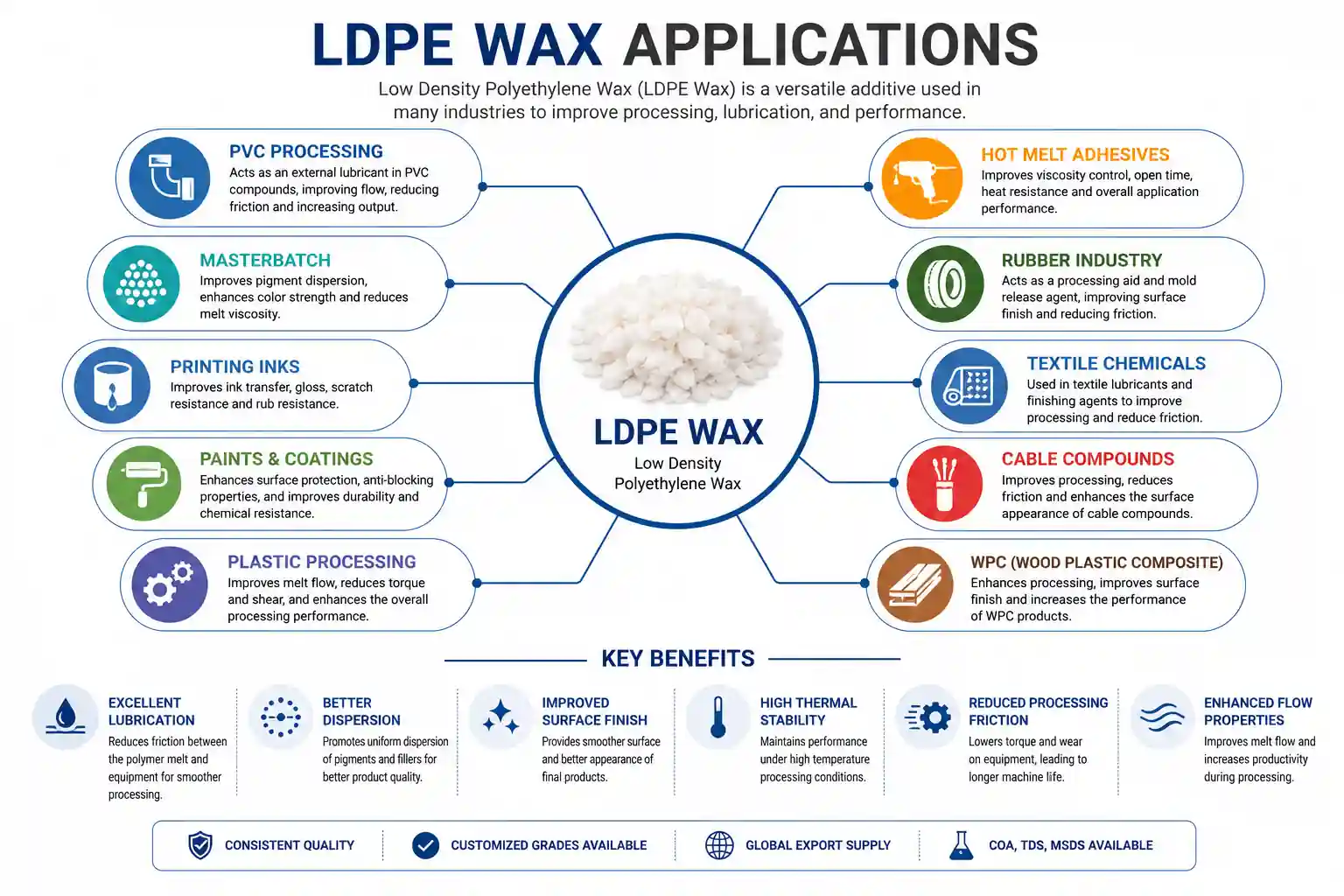
Polyethylene wax has many industrial uses because it can improve both processing and material performance.
Common applications include:
- Color masterbatch
- Black masterbatch
- White masterbatch
- Filler masterbatch
- PVC processing
- Polymer compounding
- Plastic processing
- Hot melt adhesives
- Coatings
- Printing inks
- Rubber compounds
- Pigment dispersion
- Filler dispersion
- Mold release
- Wax blending
- Surface treatment products
In addition, each application may need different technical properties. Therefore, buyers should choose the product according to temperature, viscosity, polymer type, and final use.
Use in Masterbatch Production
Masterbatch is one of the main uses for this type of polyethylene wax.
During production, pigments and fillers must spread evenly through the carrier polymer. Otherwise, poor dispersion may create color spots, weak color strength, or an uneven surface.
For this reason, polyethylene wax can improve pigment and filler distribution. Moreover, it may support smoother flow during mixing and extrusion.
As a result, producers can achieve better color consistency and more stable processing.
Typical applications include:
- Color masterbatch
- Black masterbatch
- White masterbatch
- Filler masterbatch
- Additive masterbatch
- PE-based compounds
- PP-based compounds
However, the correct grade depends on pigment loading, carrier resin, processing temperature, and viscosity requirements.
Use in PVC Processing
Low Density Polyethylene Wax can also work as a lubricant in PVC production.
During processing, friction develops between PVC, additives, equipment, and metal surfaces. Therefore, good lubrication helps maintain stable production.
The wax can reduce friction and improve material flow. In addition, it may support easier release and better surface quality.
Common applications include:
- PVC pipes
- PVC profiles
- PVC sheets
- PVC fittings
- PVC cables
- PVC flooring
- Rigid PVC compounds
However, dosage is important. Too little lubrication may make processing difficult, while excessive lubrication can affect fusion.
Therefore, PVC producers should select the wax according to the exact formulation.
Hot Melt Adhesive Applications
Polyethylene wax also has applications in hot melt adhesives.
In these systems, the wax can help control viscosity during heating. Moreover, it may improve flow and processing behavior.
As a result, adhesive producers can adjust application properties according to their needs.
However, each formula contains different resins, tackifiers, oils, and additives. For this reason, compatibility testing is recommended before large-scale production.
Polymer Compounding
This wax can also support polymer compounding.
For example, it may help pigments, fillers, and additives spread more evenly through the polymer. In addition, the material can improve flow during mixing and extrusion.
Therefore, producers may achieve smoother processing and better product consistency.
Final performance, however, depends on the polymer type, temperature, dosage, and wax grade. As a result, technical testing is important for demanding applications.
Coatings and Paints
Polyethylene wax is widely used in coating and paint systems.
Depending on the grade, it may improve:
- Surface slip
- Scratch resistance
- Abrasion behavior
- Surface feel
- Dispersion
- Processing performance
Moreover, suitable grades can support better surface properties.
However, each coating system behaves differently. Therefore, buyers should check viscosity, melting behavior, physical form, and compatibility before use.
Printing Ink Applications
Printing ink producers can also use polyethylene wax to improve surface and processing behavior.
For example, suitable grades may support dispersion, slip, and rub resistance. In addition, the material can influence the final surface feel.
Typical uses include:
- Packaging inks
- Industrial printing inks
- Surface printing systems
- Specialty inks
Because ink systems vary, producers should select a grade according to the binder, production temperature, and required properties.
Rubber Processing
This material can also support selected rubber formulations.
Depending on the compound, it may improve lubrication, additive distribution, and release during processing. Therefore, rubber producers may achieve easier handling and smoother production.
However, dosage and compatibility remain important. For this reason, producers should test the selected grade before regular use.
Wax Blending
LDPE Wax can also be blended with paraffin wax and other synthetic waxes.
For example, manufacturers may use wax blends to adjust:
- Hardness
- Softening behavior
- Viscosity
- Flow
- Surface properties
- Processing performance
- Production cost
Moreover, blending allows manufacturers to balance different wax properties in one formulation.
Therefore, the final ratio should depend on the required application and product performance.
Technical Properties
Technical properties vary between polyethylene wax grades.
Therefore, buyers should check the exact specification before ordering.
| Property | Why It Matters |
|---|---|
| Appearance | Shows physical form and consistency |
| Color | Important for light-colored products |
| Melting Point | Helps define processing temperature |
| Softening Point | Shows heat behavior |
| Melt Viscosity | Affects flow and dispersion |
| Density | Helps identify grade properties |
| Molecular Weight | Influences processing behavior |
| Penetration | Indicates relative hardness |
| Moisture | Important for storage and production |
| Physical Form | Powder, flakes, pellets, or granules |
In particular, viscosity and melting behavior can strongly affect processing. Moreover, different applications may require different limits.
For this reason, buyers should always use the latest TDS and COA for the offered grade.
LDPE Wax vs LDPE Resin
LDPE Wax and LDPE resin are different products.
LDPE resin is a higher molecular weight polymer. Producers commonly use it as the main raw material for:
- Plastic films
- Bags
- Flexible packaging
- Containers
- Cable insulation
- Molded products
In contrast, the wax has a much lower molecular weight. Therefore, it mainly works as an additive.
Its common functions include:
- Lubrication
- Pigment dispersion
- Filler dispersion
- Flow improvement
- Processing support
- Mold release
- Surface modification
As a result, buyers should not use LDPE resin specifications to evaluate a wax grade.
LDPE Wax vs HDPE Wax
Both products belong to the polyethylene wax family. However, their density, structure, hardness, viscosity, and processing behavior may differ.
Therefore, one grade cannot automatically replace another.
For example, a masterbatch producer may focus mainly on dispersion. Meanwhile, a PVC producer may need stronger lubrication.
A coating producer, on the other hand, may focus more on melting and surface behavior.
For this reason, technical data should guide the final selection.
LDPE Wax vs PE Wax
PE Wax means Polyethylene Wax and refers to the wider product family.
Low Density Polyethylene Wax is one type within this family. Other products may include:
Therefore, buyers should not select a grade only by the name PE Wax.
Instead, they should compare melting point, viscosity, density, physical form, and application requirements.
How to Select the Right Grade
Choosing the right product starts with the final use.
For example, masterbatch producers may need better pigment dispersion. Meanwhile, PVC manufacturers may focus on lubrication.
Hot melt adhesive producers may give more importance to viscosity and compatibility.
Therefore, buyers should provide:
- Application
- Required melting point
- Required viscosity
- Required density
- Preferred physical form
- Processing temperature
- Required quantity
- Packing requirement
- Final product requirements
With this information, we can recommend a more suitable grade.
In addition, customers with strict requirements should review the TDS, COA, and sample before bulk production.
Packing and Storage
The product can be available in several physical forms.
Common forms include:
- Powder
- Flakes
- Granules
- Pellets
Moreover, packing can vary according to grade and order size.
Therefore, buyers should confirm bag weight, pallet arrangement, jumbo bag availability, and container loading quantity before ordering.
For proper storage, keep the product in a clean and dry area. In addition, protect it from direct sunlight, moisture, contamination, and strong heat.
Supply and Export
IranParaffinWax.com supplies polyethylene wax products to international industrial markets.
Depending on destination and order terms, available Incoterms may include:
- EXW
- FCA
- FOB
- CFR
- CIF
- CPT
Moreover, shipments can include commercial and technical documents for the supplied product.
Available documents may include:
- Commercial Invoice
- Packing List
- Certificate of Analysis
- Technical Data Sheet
- Material Safety Data Sheet
- Certificate of Origin when applicable
Therefore, customers should mention any special document requirements before confirming an order.
LDPE Wax Supplier from Iran
IranParaffinWax.com supplies LDPE Wax to manufacturers, importers, traders, and distributors.
For an accurate offer, please provide:
- Required quantity
- Monthly or annual demand
- Application
- Required specification
- Packing requirement
- Destination country
- Destination port
- Preferred Incoterm
After receiving these details, we can check available grades and prepare the quotation.
In addition, customers can request TDS, COA, MSDS, packing information, delivery terms, and current prices.
LDPE Wax Price
The LDPE wax price depends on several factors.
These include grade, specification, quantity, physical form, packing, raw material cost, freight rate, destination, and Incoterm.
Therefore, one fixed price cannot apply to every shipment.
For the latest offer, buyers should provide their required quantity, application, destination port, and preferred delivery term.
Frequently Asked Questions
What is LDPE Wax?
It is a low molecular weight polyethylene wax mainly used as an industrial additive. For example, it can support lubrication, dispersion, flow, and processing.
What is it used for?
Common uses include masterbatch, PVC, coatings, printing inks, adhesives, polymer compounds, rubber processing, and wax blends.
Is it the same as LDPE resin?
No. LDPE resin mainly works as the primary polymer in films, packaging, and plastic products. In contrast, polyethylene wax mainly serves as an additive.
Can it be used in masterbatch?
Yes. Suitable grades can support pigment and filler dispersion. Moreover, they may improve flow during mixing and extrusion.
Can it be used in PVC?
Yes. Polyethylene wax can work as a lubricant in PVC. However, the correct grade and dosage depend on the formulation.
Can it be used in hot melt adhesives?
Yes. Suitable wax grades can help control viscosity and processing behavior. However, producers should first check compatibility with the complete adhesive system.
What properties should buyers check?
Buyers commonly check melting point, viscosity, density, molecular weight, softening point, color, and physical form. Therefore, the final selection should follow the required application.
What is the current price?
Price depends on grade, quantity, specification, packing, freight, destination, and Incoterm. Therefore, buyers should request a quotation for their exact requirement.
Can you provide TDS, COA and MSDS?
Yes. We can provide technical documents for the exact offered grade. In addition, buyers can request these documents before confirming an order.