

Paraffin Wax Price 2026 – Current Price per Ton & KG
Looking for the current paraffin wax price in 2026? Paraffin wax prices depend mainly on oil content, melting point, refining level, packing, order quantity, and delivery terms.
For bulk buyers, current Iran EXW prices for semi refined paraffin wax are approximately USD 840–970 per metric ton, depending on the selected grade and specification.
We supply paraffin wax for international buyers, distributors, candle manufacturers, packaging companies, and industrial users. Buyers can request EXW, FOB, CFR, or CPT quotations according to destination and shipment quantity.
Current Paraffin Wax Price 2026
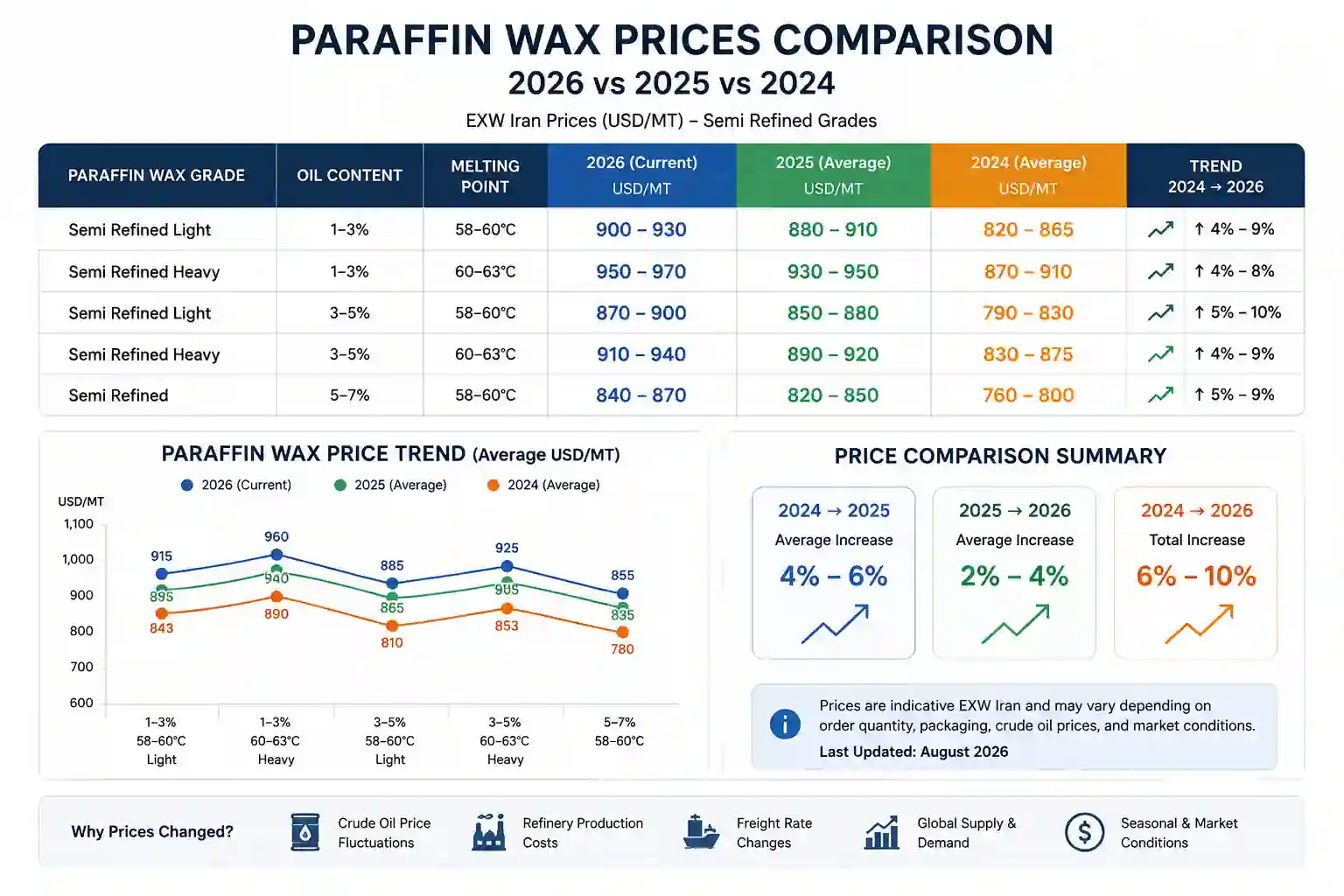
The table below shows our current indicative EXW paraffin wax prices for bulk orders.
| Paraffin Wax Grade | Oil Content | Melting Point | EXW Price USD/MT |
|---|---|---|---|
| Semi Refined Light | 1–3% | 58–60°C | $900–930 |
| Semi Refined Heavy | 1–3% | 60–63°C | $950–970 |
| Semi Refined Light | 3–5% | 58–60°C | $870–900 |
| Semi Refined Heavy | 3–5% | 60–63°C | $910–940 |
| Semi Refined | 5–7% | 58–60°C | $840–870 |
Last Updated: August 2026
These are indicative EXW prices and may change according to raw material costs, production availability, packing, order quantity, and market conditions.
For the latest price, send us your required grade, quantity, packing, and destination.
Paraffin Wax Price per Ton
Bulk paraffin wax is normally quoted in USD per metric ton (USD/MT).
Current semi refined paraffin wax prices range approximately from:
USD 840 to 970 per metric ton EXW
The exact price depends primarily on oil content and melting point.
For example, semi refined paraffin wax with 5–7% oil content is generally more economical, while lower-oil and higher-melting grades usually command higher prices.
For container orders, buyers should also consider packing, inland transportation, port charges, ocean freight, and other logistics costs when calculating the final landed price.
Paraffin Wax Price per KG
Based on current bulk EXW prices, semi refined paraffin wax costs approximately:
USD 0.84–0.97 per kg
This is the equivalent bulk price calculated from the metric-ton prices above.
For example:
$840/MT = $0.84/kg
$900/MT = $0.90/kg
$970/MT = $0.97/kg
Retail paraffin wax prices per kilogram can be considerably higher because retail products include smaller packing, warehousing, distribution, and retailer margins.
Therefore, buyers comparing bulk industrial prices with online retail prices should consider the difference in order quantity and packing.
Iran Paraffin Wax Price
Iran is an important source of paraffin wax for international markets due to its petroleum refining industry and competitive production costs.
We supply different grades of Iran paraffin wax for bulk export, including:
- Fully refined paraffin wax
- Semi refined paraffin wax 1–3%
- Semi refined paraffin wax 3–5%
- Semi refined paraffin wax 5–7%
- Light melting point grades
- Heavy melting point grades
Prices vary according to the required specification.
For an accurate quotation, buyers should specify the required oil content and melting point instead of requesting only a general paraffin wax price.
Semi Refined Paraffin Wax Price
Semi refined paraffin wax provides a cost-effective option for many industrial applications.
The main commercial grades include:
Semi Refined Paraffin Wax 1–3%
Our current EXW price for 1–3% oil content, 58–60°C is approximately:
USD 900–930/MT
For the heavier 60–63°C grade:
USD 950–970/MT
Semi Refined Paraffin Wax 3–5%
Current EXW prices are approximately:
58–60°C: USD 870–900/MT
60–63°C: USD 910–940/MT
Semi Refined Paraffin Wax 5–7%
This is currently one of the more economical semi refined grades.
Indicative EXW price:
USD 840–870/MT
It is suitable for industrial applications where very low oil content is not required.
Fully Refined Paraffin Wax Price
Fully refined paraffin wax generally costs more than semi refined grades because it undergoes additional refining and has a lower oil content.
Typical fully refined paraffin wax has an oil content of approximately 0.5–1% or lower, depending on the grade.
The final price depends on:
- Oil content
- Melting point
- Color
- Packing
- Quantity
- Required specification
- Delivery term
For the current fully refined paraffin wax price, contact our sales team with your required specification and destination.
Paraffin Wax Price by Oil Content
Oil content is one of the most important factors affecting paraffin wax prices.
| Grade | Typical Oil Content | Relative Price |
|---|---|---|
| Fully Refined | 0.5–1% or lower | Highest |
| Semi Refined | 1–3% | Higher |
| Semi Refined | 3–5% | Medium |
| Semi Refined | 5–7% | More Economical |
Lower oil content generally requires additional refining. As a result, lower-oil grades typically cost more.
However, the most expensive grade is not always the best choice.
Industrial buyers should select the grade according to their actual production requirements.
Does Melting Point Affect Paraffin Wax Price?
Yes. Melting point is another important specification when comparing paraffin wax quotations.
Common ranges include:
56–58°C
58–60°C
60–62°C
60–63°C
62–64°C
Prices can differ between light and heavy grades even when their oil contents are similar.
For this reason, a professional inquiry should include both parameters.
For example:
Semi Refined Paraffin Wax, 1–3% Oil, Melting Point 58–60°C
is a more precise request than simply:
Paraffin Wax 1–3%
What Affects Paraffin Wax Prices?
Paraffin wax prices can change according to both technical specifications and market conditions.
The main factors are:
Oil Content
Lower oil content normally requires additional refining and therefore affects production cost.
Melting Point
Different melting point ranges require different feedstocks and production specifications. Heavy grades can therefore have different prices from light grades.
Raw Material Costs
Paraffin wax is produced from petroleum-derived feedstocks. Changes in feedstock and refinery costs can affect the final wax price.
Packing
Export packing also affects the final quotation.
Common options include cartons, bags, slabs, and other suitable industrial packing.
Order Quantity
Full-container and regular bulk orders can have different commercial conditions from small-volume purchases.
Freight
For FOB, CFR and CPT quotations, transportation costs can significantly affect the final price.
Freight depends on destination, shipment method, container availability, and current logistics conditions.
Payment Terms
Payment conditions can also affect commercial quotations, particularly for international transactions.
EXW vs FOB vs CFR Paraffin Wax Price
When comparing paraffin wax prices from different suppliers, always check the Incoterm.
EXW – Ex Works
The quoted price covers the product at the seller’s designated facility. The buyer arranges transportation and subsequent logistics according to the agreed Incoterm responsibilities.
FOB – Free on Board
The seller delivers the goods on board the nominated vessel at the agreed port of shipment.
CFR – Cost and Freight
The seller pays the cost and ocean freight required to transport the goods to the agreed destination port. Insurance is not included under CFR.
Therefore:
$900/MT EXW and $900/MT CFR are not comparable quotations.
Always compare offers based on the same product specification, packing, quantity, and Incoterm.
Paraffin Wax Packing and Bulk Orders
Paraffin wax can be supplied in different packing depending on grade and customer requirements.
Common export packing includes:
- Cartons
- Bags
- Slabs
- Pellets or granules where applicable
- Palletized packing
Packing should always be specified when requesting a price because it can affect both product and freight costs.
For international orders, provide the required packing together with the destination to receive an accurate quotation.
How to Get the Best Paraffin Wax Price
The cheapest quotation is not necessarily the most economical option.
Before comparing suppliers, check:
- Oil content
- Melting point
- Net weight
- Packing
- Origin
- COA
- Delivery term
- Freight
- Payment terms
Two suppliers may quote different prices because they are offering different grades or delivery conditions.
For example, comparing a 5–7% oil semi refined grade with a 1–3% oil grade based only on USD/MT would not provide a fair comparison.
How to Request a Paraffin Wax Quotation
For a precise quotation, send the following information:
Product: Paraffin Wax
Oil Content: e.g. 1–3%
Melting Point: e.g. 58–60°C
Quantity: e.g. 20 MT
Packing: Carton / Bag / Required Packing
Destination: Port or City
Delivery Term: EXW / FOB / CFR / CPT
This information allows us to calculate the appropriate product and logistics price.
Paraffin Wax Applications
Different paraffin wax grades are used in:
- Candle manufacturing
- Packaging
- Paper and board coating
- Cosmetics
- Rubber processing
- Textile applications
- Polishes
- Adhesives
- Industrial coatings
- Wax blends
- Electrical applications
The appropriate grade depends on the required oil content, melting point, color, hardness, and final application.
Frequently Asked Questions About Paraffin Wax Price
What is the current paraffin wax price in 2026?
Current Iran EXW prices for our semi refined paraffin wax grades are approximately USD 840–970 per metric ton, depending on oil content and melting point.
How much is paraffin wax per kg?
Based on current bulk EXW prices, semi refined paraffin wax is approximately USD 0.84–0.97/kg.
How much is one ton of paraffin wax?
Current semi refined paraffin wax prices are approximately USD 840–970 per metric ton EXW, depending on grade.
Which paraffin wax grade is the cheapest?
Among the grades currently listed, semi refined paraffin wax with 5–7% oil content has the lowest indicative EXW price at approximately USD 840–870/MT.
Why is fully refined paraffin wax more expensive?
Fully refined paraffin wax generally requires additional processing to achieve lower oil content and higher purity. Therefore, it usually commands a higher price than semi refined grades.
Does melting point change the price?
Yes. For example, the current price of 1–3% semi refined wax at 58–60°C differs from the 60–63°C heavy grade.
Can I get FOB or CFR paraffin wax prices?
Yes. FOB, CFR, CPT and other quotations can be calculated according to destination, shipment quantity, packing, and current freight costs.
Are paraffin wax prices fixed?
No. Prices can change according to raw material costs, production conditions, supply and demand, packing, freight, and other market factors.
Buy Paraffin Wax in Bulk
We supply fully refined and semi refined paraffin wax for bulk international orders.
Available grades include different oil contents and melting points for candle manufacturing, packaging, cosmetics, rubber, textile, coating, and other industrial applications.
COA, TDS and SDS/MSDS are available according to the supplied grade.
For the latest paraffin wax price, send us your required grade, quantity, packing, and destination to receive a current quotation.