

Difference Between Glycerin, Glycerine and Glycerol
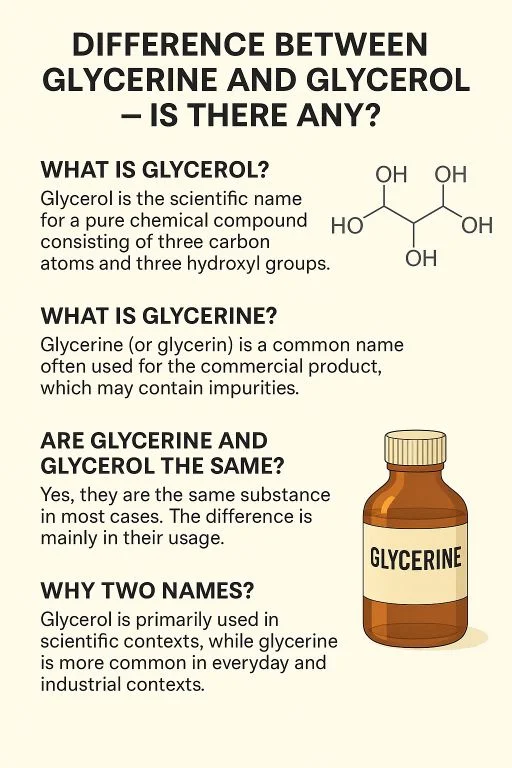
Glycerin, glycerine, and glycerol are three terms that often appear on product labels, technical documents, cosmetic formulations, pharmaceutical products, and chemical specifications. This raises a common question: What is the difference between glycerin and glycerol?
The short answer is simple: glycerin, glycerine, and glycerol generally refer to the same chemical substance, C₃H₈O₃. Glycerol is the systematic chemical name, while glycerin and glycerine are commonly used names in commercial and industrial contexts.
However, product grade, purity, source, and specification can differ significantly. Therefore, buyers should not assume that every product sold as glycerin has exactly the same quality or is suitable for the same application.
Are Glycerin, Glycerine and Glycerol the Same?
Yes. Chemically, glycerin, glycerine, and glycerol refer to the same basic molecule.
Glycerol has the molecular formula C₃H₈O₃ and a molecular weight of approximately 92.09 g/mol. It is a triol, meaning that its molecular structure contains three hydroxyl (-OH) groups.
Table of Contents
ToggleThe main difference between the three terms is generally naming and context, rather than a different molecular structure.
Glycerol is commonly used in chemistry, scientific literature, laboratory work, and technical documentation.
Glycerin is widely used in commercial, pharmaceutical, cosmetic, food, and industrial markets.
Glycerine is an alternative spelling of glycerin and is particularly common in British English and international trade.
Therefore, seeing glycerin on one specification and glycerol on another does not automatically mean they are different chemicals.
What Is Glycerol?
Glycerol is the chemical name for the compound with the molecular formula C₃H₈O₃.
It is generally a clear, viscous, hygroscopic liquid. Because glycerol contains three hydroxyl groups, it interacts strongly with water and works effectively as a humectant and solvent.
These properties make glycerol useful in many industries, including:
- Cosmetics and personal care
- Pharmaceutical formulations
- Food processing
- Soap and detergent production
- Chemical manufacturing
- Resins and coatings
- Tobacco-related applications
- Industrial formulations
Its exact suitability depends on purity, specification, source, and regulatory requirements.
What Is Glycerin?
Glycerin is a commonly used commercial name for glycerol.
Manufacturers, suppliers, traders, and end users frequently use the term Glycerin when referring to commercial grades of glycerol.
For example, the market commonly uses terms such as:
- Refined Glycerin
- USP Grade Glycerin
- Pharmaceutical Grade Glycerin
- Food Grade Glycerin
- Cosmetic Grade Glycerin
- Technical Grade Glycerin
- Crude Glycerin
- Vegetable Glycerin
These products contain glycerol as their principal component, but their purity and specifications can vary.
Therefore, buyers should pay more attention to the grade and COA than to whether the supplier calls the product glycerin or glycerol.
Glycerin vs Glycerol: What Is the Main Difference?
The main difference between glycerin and glycerol is generally terminology and commercial usage.
| Property | Glycerol | Glycerin / Glycerine |
|---|---|---|
| Chemical formula | C₃H₈O₃ | C₃H₈O₃ |
| Chemical identity | Glycerol | Glycerol |
| Typical terminology | Scientific / chemical | Commercial / industrial |
| Common use | Laboratory and technical documents | Product labels and trade |
| Available grades | Various | Various |
| Purity | Depends on grade | Depends on grade |
| Physical form | Viscous liquid | Viscous liquid |
It is therefore misleading to say that glycerol always means pure material while glycerin always means an impure product.
Commercial glycerin can have very high purity. For example, refined grades may contain approximately 99.5% or more glycerol depending on the applicable specification.
Glycerin vs Glycerine: Is There Any Difference?
There is normally no chemical difference between glycerin and glycerine.
They are alternative spellings of the same name.
Glycerin is particularly common in American English and commercial terminology, while glycerine is widely used in British English and international markets.
For SEO and international trade, buyers may therefore search for all of the following:
- glycerin
- glycerine
- glycerol
- refined glycerin
- refined glycerine
- glycerol supplier
All can refer to products based on the same chemical compound.
Why Are Different Names Used?
The chemical industry often uses different names for the same substance depending on the market, technical standard, language, and application.
Scientists and laboratories usually prefer glycerol because it identifies the chemical compound directly.
Meanwhile, manufacturers and suppliers commonly use glycerin or glycerine on product labels, commercial invoices, quotations, technical data sheets, and marketing materials.
For buyers, the name itself is therefore less important than the product specification.
Does Glycerin Purity Matter?
Yes. This is where the real differences between commercial glycerin products appear.
Two products may both be called glycerin but have very different specifications.
Important parameters can include:
- Glycerol content
- Water content
- Color
- Specific gravity
- Chloride content
- Sulfate content
- Ash
- Heavy metals
- Fatty acids and esters
- Residue on ignition
- DEG and related compounds
The required specification depends on the final application.
For example, a manufacturer producing cosmetics or pharmaceutical formulations may require a much more controlled grade than a company using glycerin for a general industrial application.
Crude Glycerin vs Refined Glycerin
The distinction between crude glycerin and refined glycerin is much more important than the distinction between the words glycerin and glycerol.
Crude glycerin can contain water, salts, organic matter, residual catalysts, and other impurities depending on its production process.
Refining removes many of these impurities and increases glycerol concentration.
As a result, refined glycerin can serve applications that require higher purity and tighter specifications.
Buyers should therefore specify whether they require crude, technical, refined, food, cosmetic, pharmaceutical, USP, or another grade.
Vegetable Glycerin vs Synthetic Glycerin
Glycerin can also differ according to its source.
Vegetable glycerin is produced from vegetable oils and is widely used in cosmetics, personal care, food, pharmaceutical, and other formulations when the required grade and specifications are met.
Glycerol can also be produced through other manufacturing routes.
Despite different production sources, the glycerol molecule remains C₃H₈O₃. What can differ is the product’s purity, impurity profile, certification, traceability, and suitability for a particular application.
Therefore, buyers who specifically require vegetable-origin glycerin should state this requirement when requesting a quotation.
Glycerin in Cosmetics and Personal Care
Glycerin is widely used as a humectant in cosmetic and personal care formulations.
It can help attract and retain moisture, which explains its widespread use in products such as:
- Moisturizing creams
- Lotions
- Facial products
- Hand creams
- Shampoos
- Conditioners
- Shower gels
- Liquid soaps
- Toothpaste
- Personal care formulations
However, cosmetic manufacturers should select the appropriate grade according to their formulation and applicable standards.
Glycerin in Pharmaceutical Applications
High-purity glycerin also has applications in pharmaceutical formulations.
Depending on the grade and formulation, manufacturers may use it as a:
- Humectant
- Solvent
- Sweetening component
- Viscosity modifier
- Formulation aid
Pharmaceutical buyers should request the relevant specification, COA, and required compliance documentation before purchasing.
Glycerin in Food Applications
Suitable grades of glycerin can also be used in food and beverage manufacturing.
Depending on local regulations and formulation requirements, glycerin can provide functions such as:
- Moisture retention
- Texture control
- Solvent action
- Sweetness
- Product stability
Food manufacturers must use an appropriate food-grade material and verify compliance with the regulations of the destination market.
Industrial Uses of Glycerin
Technical and refined glycerin grades also serve numerous industrial applications.
Common applications include:
- Chemical formulations
- Resins
- Coatings
- Textile processing
- Lubricant formulations
- Cleaning products
- Soap manufacturing
- Plastic-related formulations
- Industrial processing aids
- biodiesel
The correct grade depends on the manufacturing process and required technical properties.
How to Choose the Correct Glycerin Grade
When purchasing glycerin, do not select the product based only on its name.
Instead, provide the supplier with:
- Required purity
- Final application
- Required standard or grade
- Required quantity
- Packing
- Destination
- Required documentation
For example, requesting only “glycerin” may not provide enough information for an accurate quotation.
A better inquiry would specify:
Refined Glycerin 99.5% Min, Industrial Grade, 20 MT, IBC Packing, CFR Destination Port
This allows the supplier to select the appropriate grade and provide a more accurate offer.
Glycerin, Glycerine and Glycerol Comparison
The simplest way to understand the terminology is:
Glycerol = chemical name
Glycerin = common commercial name
Glycerine = alternative spelling of glycerin
All three terms can refer to the same chemical compound.
However, grade, purity, origin and specification can vary between products. Therefore, international buyers should always check the COA or TDS before placing an order.
Frequently Asked Questions About Glycerin and Glycerol
Is glycerin the same as glycerol?
Yes. Glycerin is a commonly used name for glycerol. Both generally refer to the chemical compound C₃H₈O₃.
Is glycerine the same as glycerin?
Yes. Glycerine and glycerin are alternative spellings and normally refer to the same substance.
Is glycerol always purer than glycerin?
No. The word glycerol does not automatically guarantee a higher purity. Commercial glycerin is available in different grades and can also have very high glycerol content. Buyers should check the specification and COA rather than relying on the product name alone.
What is the chemical formula of glycerol?
The molecular formula of glycerol is C₃H₈O₃, and its molecular weight is approximately 92.09 g/mol.
What is refined glycerin?
Refined glycerin is glycerin that has undergone purification to reduce impurities and achieve a specified glycerol concentration and quality level.
What is vegetable glycerin?
Vegetable glycerin is glycerin produced from vegetable-based feedstocks. Buyers requiring vegetable origin should request appropriate documentation from the supplier.
Which glycerin grade should I buy?
It depends on the application. Cosmetic, pharmaceutical, food, and industrial manufacturers can require different purity levels and specifications. Buyers should provide their application and required standard before ordering.
Conclusion: Glycerin vs Glycerol
There is no fundamental chemical difference between glycerin, glycerine, and glycerol. They generally refer to the same compound, C₃H₈O₃. The difference mainly comes from naming conventions and commercial usage.
The more important differences concern purity, grade, source, specification, and intended application.
Therefore, buyers should compare the COA, glycerol content, water content, color, impurities, required standard, and product origin before purchasing.
For international orders, buyers can request the appropriate glycerin grade based on application, quantity, packing, and destination.
