

Paraffin Wax vs Microcrystalline Wax: Composition, Properties & Uses
Paraffin wax and microcrystalline wax are both petroleum-derived waxes, but they differ significantly in composition, crystal structure, flexibility, melting point and industrial performance.
Paraffin wax mainly contains relatively straight-chain saturated hydrocarbons and typically forms larger, more defined crystals. Microcrystalline wax contains a higher proportion of branched and cyclic saturated hydrocarbons and forms much smaller crystals.
As a result, paraffin wax is generally harder and more crystalline, while microcrystalline wax is usually more flexible, adhesive and resistant to cracking.
The right choice depends on the application. Paraffin wax is widely used in candles, coatings, packaging and industrial formulations, while microcrystalline wax is particularly useful where flexibility, binding strength and oil retention are important.
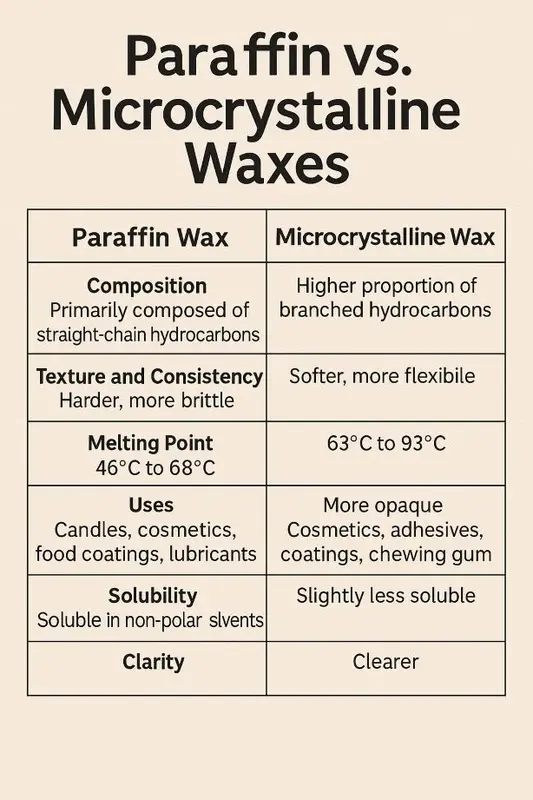
Paraffin Wax vs Microcrystalline Wax: Quick Comparison
| Property | Paraffin Wax | Microcrystalline Wax |
|---|---|---|
| Source | Petroleum refining | Petroleum refining |
| Hydrocarbon structure | Mainly straight-chain saturated hydrocarbons | More branched and cyclic saturated hydrocarbons |
| Crystal structure | Larger, more defined crystals | Very small, fine crystals |
| Texture | Harder and more brittle | Flexible, tough and tackier |
| Melting behavior | Generally lower | Generally higher |
| Flexibility | Lower | Higher |
| Adhesiveness | Lower | Higher |
| Oil retention | Lower | Higher |
| Crack resistance | Lower | Higher |
| Typical uses | Candles, coatings, packaging, polishes | Cosmetics, adhesives, rubber, blends, protective coatings |
The most important difference is therefore not simply their petroleum origin. Their molecular composition and crystal structure produce noticeably different physical properties.
Table of Contents
ToggleWhat Is Paraffin Wax Made Of?
Paraffin wax is a mixture of saturated hydrocarbons obtained primarily during petroleum refining.
Commercial paraffin wax does not consist of one molecule and therefore does not have one exact molecular formula. Instead, it contains a distribution of hydrocarbon chains.
These hydrocarbons are predominantly alkanes with the general formula:
CnH₂n+₂
The exact composition depends on the petroleum feedstock and refining process.
This relatively simple hydrocarbon composition contributes to the characteristic appearance, crystallinity, water resistance and melting behavior of paraffin wax.
Paraffin Wax Composition
The composition of paraffin wax consists primarily of saturated hydrocarbons with relatively long carbon chains.
Commercial grades may also contain different amounts of oil. This is why paraffin wax is commonly classified according to characteristics such as:
- Oil content
- Melting or congealing point
- Color
- Penetration
- Refining level
- Physical form
Fully refined and semi-refined paraffin waxes can therefore behave differently even though both belong to the same general family of petroleum waxes.
The composition is particularly important when choosing wax for Candles, coatings, packaging, rubber processing and other industrial applications.
Properties of Paraffin Wax
Paraffin wax is valued because it combines several useful physical and chemical characteristics.
Typical properties include:
Water resistance: Paraffin is hydrophobic and does not readily mix with water.
Chemical stability: Saturated hydrocarbons are relatively stable under normal storage and application conditions.
Crystallinity: Paraffin tends to form relatively large and well-defined crystals.
Low odor in refined grades: Higher refining levels can produce white wax with low odor.
Controlled melting behavior: Different commercial grades are available with different melting or congealing ranges.
Electrical insulation: Paraffin’s nonpolar hydrocarbon structure can provide useful insulating properties in suitable applications.
However, paraffin wax can be relatively brittle compared with microcrystalline wax. This difference becomes important when flexibility and crack resistance are required.
What Is Microcrystalline Wax?
Microcrystalline wax is another petroleum-derived wax, but its molecular composition and crystal structure differ from those of conventional paraffin wax.
It contains a greater proportion of branched and cyclic saturated hydrocarbons. These molecules do not pack together as uniformly as the more linear hydrocarbons commonly associated with paraffin wax.
Consequently, microcrystalline wax forms very small crystals—hence the name microcrystalline.
This structure generally gives it greater flexibility, toughness, tackiness and oil-binding capacity.
What Is Microcrystalline Wax Made Of?
Microcrystalline wax consists of a complex mixture of high-molecular-weight saturated hydrocarbons.
Compared with Paraffin wax, its hydrocarbon molecules tend to have:
- More branching
- More cyclic structures
- Higher molecular weight
- More complex molecular arrangements
Because microcrystalline wax is also a mixture, it does not have one exact chemical formula.
Its composition depends on the petroleum feedstock and refining conditions used during production.
Microcrystalline Wax Structure
The microcrystalline wax structure is one of the main reasons it behaves differently from paraffin wax.
Paraffin molecules can arrange themselves into comparatively larger crystalline structures. In contrast, the branched and cyclic molecules in microcrystalline wax interfere with regular crystal formation.
This produces much smaller crystals.
The fine crystal structure contributes to:
- Greater flexibility
- Better adhesion
- Higher toughness
- Improved crack resistance
- Better oil retention
- Better compatibility in certain wax blends
This structural difference is particularly important when microcrystalline wax is blended with paraffin wax to modify the performance of the finished product.
Microcrystalline Wax Chemical Structure
Microcrystalline wax does not have one uniform chemical structure because it contains many different hydrocarbon molecules.
Chemically, however, it consists mainly of saturated hydrocarbons with more complex molecular structures than those typically dominant in paraffin wax.
The greater degree of branching helps explain why microcrystalline wax is less crystalline and generally more flexible.
Therefore, the difference between the two waxes begins at the molecular level and continues into their physical and industrial properties.
Microcrystalline Wax Melting Point
Microcrystalline wax generally has a higher melting range than conventional paraffin wax, although exact values depend on grade and specification.
Commercial microcrystalline waxes are available in different melting ranges, including grades used for industrial formulations, cosmetics, rubber, coatings and wax blending.
For commercial purchasing, the exact melting or congealing point should always be checked on the product specification or Certificate of Analysis rather than assuming one value applies to every microcrystalline wax.
This is especially important because melting point can influence processing temperature, hardness, flexibility and final-product performance.
Crystal Structure: Paraffin vs Microcrystalline Wax
Crystal structure is one of the clearest differences between these two petroleum waxes.
Paraffin wax forms comparatively larger and more organized crystals.
Microcrystalline wax forms much smaller and less uniform crystals because of its more branched molecular composition.
This explains several practical differences:
Paraffin wax tends to be more rigid and can crack more easily under mechanical stress.
Microcrystalline wax tends to bend or deform more easily without cracking.
For this reason, manufacturers sometimes combine the two waxes. Paraffin can provide hardness and other desirable properties, while microcrystalline wax can improve flexibility, adhesion and resistance to cracking.
Paraffin Wax vs Microcrystalline Wax: Key Differences
1. Composition
Paraffin wax mainly contains relatively linear saturated hydrocarbons.
Microcrystalline wax contains more branched and cyclic saturated hydrocarbons.
2. Crystal Size
Paraffin wax forms larger crystals.
Microcrystalline wax forms very fine crystals.
3. Flexibility
Paraffin wax is generally more rigid.
Microcrystalline wax is generally more flexible and tough.
4. Adhesion
Microcrystalline wax normally provides better tack and adhesion than paraffin wax.
5. Oil Retention
Microcrystalline wax generally has a greater ability to bind or retain oils.
6. Crack Resistance
Paraffin wax can be more brittle.
Microcrystalline wax generally provides better resistance to cracking and deformation.
7. Melting Behavior
Microcrystalline wax generally has a higher melting range, although exact values vary significantly by grade.
Microcrystalline Wax Uses
Microcrystalline wax is used when a formulation requires properties such as flexibility, adhesion, toughness or oil retention.
Common applications include:
- Cosmetics and personal-care formulations
- Lip products
- Creams and ointment-type formulations
- Adhesives
- Rubber processing
- Tire and rubber compounds
- Protective coatings
- Polishes
- Electrical applications
- Wax blends
- Packaging formulations
- Industrial compounds
Microcrystalline wax can also be blended with paraffin wax to adjust hardness, flexibility, tack and resistance to cracking.
Your GSC data makes this section particularly important: “microcrystalline wax uses” is already around Position 4, so I would keep this heading almost exactly as written.
Paraffin Wax Uses
Paraffin wax is one of the most widely used petroleum waxes.
Common applications include:
- Candle manufacturing
- Paper and board coatings
- Packaging
- Rubber processing
- Polishes
- Waterproofing
- Electrical insulation
- Industrial coatings
- Wax blends
- Hot-melt formulations
- Cosmetic and personal-care formulations where an appropriate grade is specified
Different applications require different paraffin grades.
For example, melting point, oil content, hardness and color can significantly affect the performance of wax in the finished product.
Paraffin Wax vs Microcrystalline Wax for Candles
Paraffin wax is widely used as a primary candle wax because it provides predictable processing characteristics and is available in numerous commercial grades.
Microcrystalline wax can also be useful in candle formulations, particularly as a blending component.
Adding an appropriate amount of microcrystalline wax may modify characteristics such as:
- Flexibility
- Hardness
- Surface appearance
- Oil retention
- Adhesion
- Resistance to cracking
The appropriate blend depends on the candle formulation and desired finished properties.
Paraffin Wax vs Microcrystalline Wax in Cosmetics
Both waxes may be used in cosmetic and personal-care formulations when suitable grades meeting the required specifications are selected.
Microcrystalline wax is particularly useful for modifying texture and consistency because of its flexibility and binding properties.
It can be found in products such as lip formulations, creams, sticks and other semi-solid systems.
Paraffin wax may also be used in suitable cosmetic formulations and treatments.
However, cosmetic applications should use material that complies with the relevant purity and regulatory requirements for the intended market.
Can You Mix Microcrystalline Wax With Paraffin Wax?
Yes. Paraffin wax and microcrystalline wax can be blended together, and this is an important industrial use of microcrystalline wax.
A manufacturer may use paraffin as the primary wax and add microcrystalline wax to modify specific properties.
Depending on formulation, adding microcrystalline wax can help improve:
- Flexibility
- Adhesion
- Toughness
- Oil retention
- Crack resistance
The ideal blend ratio cannot be determined from the wax names alone. It depends on the specifications of both waxes and the required properties of the finished product.
Which Is Better: Paraffin Wax or Microcrystalline Wax?
Neither wax is universally better.
The correct choice depends on the application.
Choose paraffin wax when the formulation benefits from characteristics such as:
- Higher crystallinity
- Controlled hardness
- Broad availability
- Conventional candle or coating performance
Choose microcrystalline wax when the formulation needs:
- Greater flexibility
- Better adhesion
- Higher toughness
- Better oil retention
- Improved resistance to cracking
For some applications, the best solution is not choosing one or the other but blending paraffin wax with microcrystalline wax.
How to Select the Right Wax
Industrial buyers should compare actual specifications rather than selecting a wax based only on its general product name.
Important parameters include:
| Parameter | Why It Matters |
|---|---|
| Melting/congealing point | Determines thermal and processing behavior |
| Oil content | Influences hardness and other physical properties |
| Penetration | Helps indicate hardness/consistency |
| Color | Important for candles, cosmetics and light-colored products |
| Viscosity | Important for processing and coating applications |
| Flexibility | Important where cracking must be minimized |
| Purity | Critical for sensitive applications |
| Packaging | Relevant to handling, storage and production |
A supplier’s TDS and COA should therefore be checked before selecting a commercial grade.
Frequently Asked Questions
What is the main difference between paraffin wax and microcrystalline wax?
The main difference is their molecular and crystal structure. Paraffin wax contains more relatively straight-chain hydrocarbons and forms larger crystals, while microcrystalline wax contains more branched and cyclic hydrocarbons and forms much smaller crystals.
Is microcrystalline wax the same as paraffin wax?
No. Both are petroleum-derived waxes, but they have different molecular compositions, crystal structures and physical properties.
What is paraffin wax made of?
Paraffin wax is mainly a mixture of long-chain saturated hydrocarbons. It does not have one exact molecular formula because commercial paraffin wax contains multiple hydrocarbon molecules.
What is microcrystalline wax made of?
Microcrystalline wax is a mixture of high-molecular-weight saturated hydrocarbons with a greater proportion of branched and cyclic structures than conventional paraffin wax.
Which wax is more flexible?
Microcrystalline wax is generally more flexible and less brittle than paraffin wax.
Which wax has better adhesion?
Microcrystalline wax generally provides greater tack and adhesion.
Which wax has a higher melting point?
Microcrystalline wax generally has a higher melting range than conventional paraffin wax, although the exact value depends on the specific grade.
What is microcrystalline wax used for?
Microcrystalline wax is used in cosmetics, rubber, adhesives, coatings, polishes, packaging, wax blends and other industrial formulations where flexibility, adhesion or oil retention is useful.
Can paraffin wax and microcrystalline wax be mixed?
Yes. They are commonly blended when a manufacturer wants to combine the characteristics of paraffin wax with the flexibility and binding properties of microcrystalline wax.
Is microcrystalline wax better than paraffin wax?
It depends on the application. Microcrystalline wax is generally better when flexibility and adhesion are important, while paraffin wax is often preferred for applications requiring a more crystalline and rigid wax.
What should buyers check before ordering either wax?
Buyers should compare melting or congealing point, oil content, penetration, color, viscosity, purity, packaging and other application-specific specifications.
