

What Are the Differences Between Fully Refined and Semi Refined Paraffin Wax?
Paraffin wax serves many industries, yet not all paraffin wax types perform the same. In particular, Fully Refined Paraffin Wax and Semi Refined Paraffin Wax differ in several important ways. Although they may look similar at first, they vary greatly in processing, purity, performance, and end use. Therefore, buyers must understand these differences before making a decision.
Difference in the Refining Process Semi vs fully refining paraffin wax
First of all, the refining process creates the main difference between these two wax types.
Table of Contents
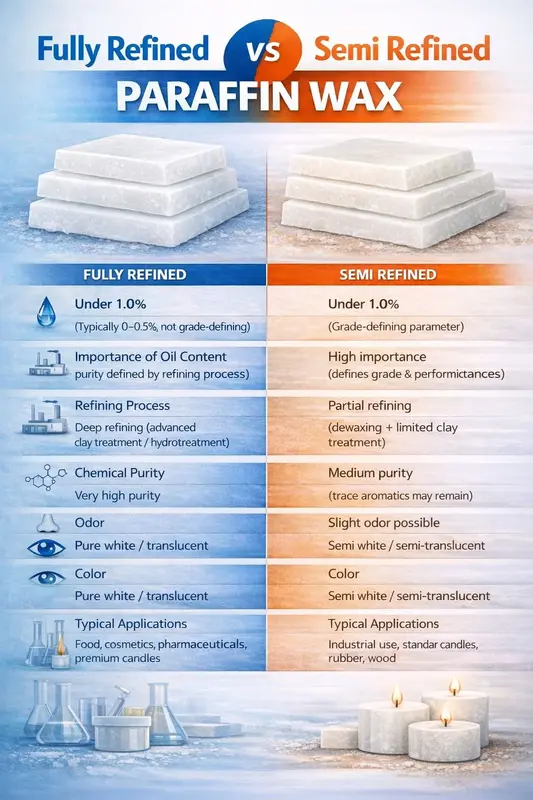
ToggleManufacturers produce semi refined paraffin wax using basic steps such as dewaxing and limited clay treatment. As a result, the process removes part of the oil and some impurities. However, it does not remove all odor-causing and aromatic compounds.
In contrast, producers apply deeper refining steps to fully refined paraffin wax. These steps include advanced clay treatment and, in many cases, hydrotreatment. Consequently, the process removes remaining impurities and unstable compounds. Because of this deeper treatment, fully refined paraffin wax reaches a much higher purity level.
Oil Content Alone Does Not Define the Wax Type
Many buyers focus only on oil content. However, this approach often leads to confusion.
In fact, both semi refined and fully refined paraffin wax can show oil content below 1%. Even so, oil percentage alone does not define the wax type. Instead, the real difference lies in the remaining chemical structure.
While semi refined wax may show low oil content, it can still contain trace aromatics and minor impurities. Fully refined wax, on the other hand, removes these substances during advanced processing. As a result, it offers cleaner and more stable performance.
Color and Visual Appearance Semi vs fully refining paraffin wax
Next, color provides a clear visual clue.
Semi refined paraffin wax usually appears light yellow or cream-colored. Although the wax looks clean, it does not achieve full brightness.
Meanwhile, fully refined paraffin wax appears white and translucent. Because the refining process removes color-causing compounds, the wax looks clearer and more uniform. Therefore, manufacturers often prefer fully refined wax for products where appearance matters.
Odor and Sensory Performance Semi vs fully refining paraffin wax
Odor plays a major role in many applications.
Semi refined paraffin wax often carries a mild petroleum smell. While industrial users may accept this, consumer products usually cannot.
By contrast, fully refined paraffin wax remains odorless. As a result, it works well in products that contact skin, food, or sensitive materials.
Chemical Purity and End-Use Safety
Chemical purity creates another key difference.
Semi refined paraffin wax fits industrial use but does not meet strict purity needs. Therefore, manufacturers avoid it in products that require direct human contact.
Fully refined paraffin wax offers high chemical purity and stability. Because of this, industries commonly use it in food packaging, cosmetics, pharmaceuticals, and hygiene products.
Typical Applications in Practice Semi vs fully refining paraffin wax
Because refining levels differ, applications also differ.
Manufacturers commonly use semi refined paraffin wax in:
-
Standard candle production
-
Matches
-
Wood treatment
-
Industrial coatings
On the other hand, industries prefer fully refined paraffin wax for:
-
Food-contact packaging
-
Cosmetics and personal care products
-
Pharmaceuticals
-
Medical and hygiene items
-
Premium odor-free candles
Price and Market Position Semi vs fully refining paraffin wax
Naturally, price also separates these two wax types.
Since fully refined paraffin wax requires more processing, it usually costs more. Meanwhile, semi refined paraffin wax offers a lower-cost option for industries that do not require high purity. Therefore, buyers must balance price against performance needs.
How Buyers Should Make the Right Choice
Ultimately, buyers should choose wax based on application requirements, not just oil content or price.
If the product serves industrial purposes without direct contact, semi refined paraffin wax often works well. However, if the application involves food, cosmetics, pharmaceuticals, or premium consumer goods, fully refined paraffin wax provides the correct solution.
For this reason, buyers should always review the Certificate of Analysis (COA) and confirm the refining process before purchase.
Final Thoughts Semi vs fully refining paraffin wax
In summary, the difference between fully refined and semi refined paraffin wax goes far beyond simple appearance or oil percentage. Instead, the refining process defines purity, odor, safety, and usability.
By understanding these differences, buyers can avoid costly mistakes, meet quality standards, and achieve consistent results. As a result, choosing the correct paraffin wax supports both product quality and long-term business success.
